 Observatory
 Astro Images
Welcome to the Mike Dodd's and Louise Kurylo's backyard observatory in Louisa County, Virginia USA, about halfway between Richmond, the state capital, and Charlottesville, home of Thomas Jefferson.
Use the navigation bar at left to explore. We hope you enjoy our photographs of the night sky, and pictures of our observatory and telescope.
|
Observatory
|
Astro Images
|
This is the Clear Sky Chart for our observatory.
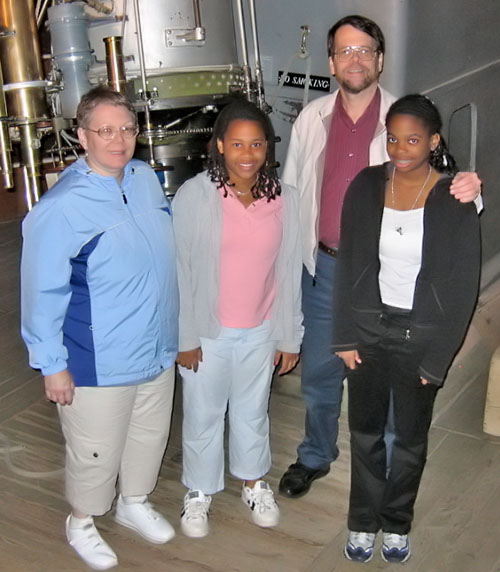
On June 22, 2004 our family visited the Lowell Observatory in Flagstaff, Arizona, and spent some time looking through the 24" Clark refractor, behind us in this photo.
In 1894 Percival Lowell, a wealthy Bostonian, set up his own observatory in Flagstaff, and on July 23, 1896, he installed the 24" objective lens onto a 32-foot long tube and viewed the dark Arizona sky. You can learn more about the Lowell Observatory and its telescopes at www.lowell.edu/.
The f/16 refractor weighs six tons (2-ton tube, 1-ton counterweights, 3-ton "other movable"); the German equatorial mount weighs another seven tons. To aim the telescope, the observer uses the "Armstrong method" – shove it around by hand. Once aimed, clutches are engaged and a clock drive tracks the target.
When we visited, the Observatory staff had some difficulty finding targets, and later decided the "clock" (indicator) that displays the right ascension needed adjustment. Views though the scope were bright and crisp, and we could detect some color in M51, the Whirpool Galaxy.
This photo shows the rear of the Clark 24" telescope. The controls are, roughly clockwise from the left:
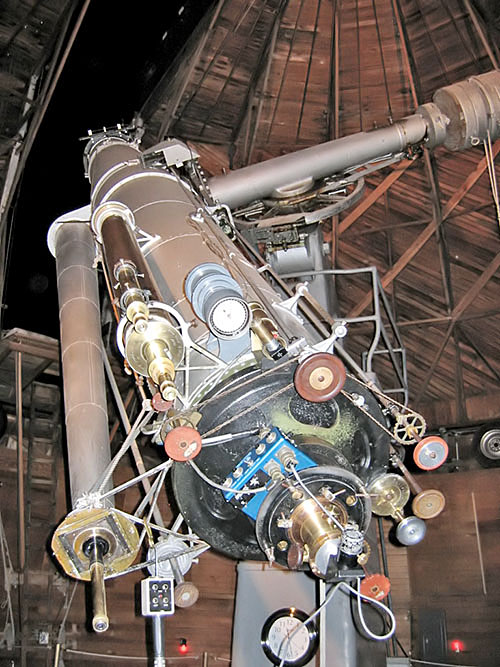
Interestingly, the same techniques used to process astronomy images dramatically improved this shot. Taken with a digital point-and-shoot camera having a puny built-in flash, parts of the telescope close to the camera were correctly exposed, but the objective end was not. Worse, the observatory dome was completely lost in darkness. However, application of levels and curves in Photoshop revealed the hidden details, as you can see here.
Updated January 1, 2025