The huge Rosette Nebula (NGC2244) is located in the constellation Monoceros, and measures about 90 to 100 light years across (540 trillion to 600 trillion miles). It is estimated to contain hydrogen gas about 10,000 times the mass of our sun, and lies about 5,000 light years away (30 quadrillion miles). In the center of the nebula, stars are forming from the gas cloud, and eroding it by their intense radiation that also excites the gas, causing it to glow.
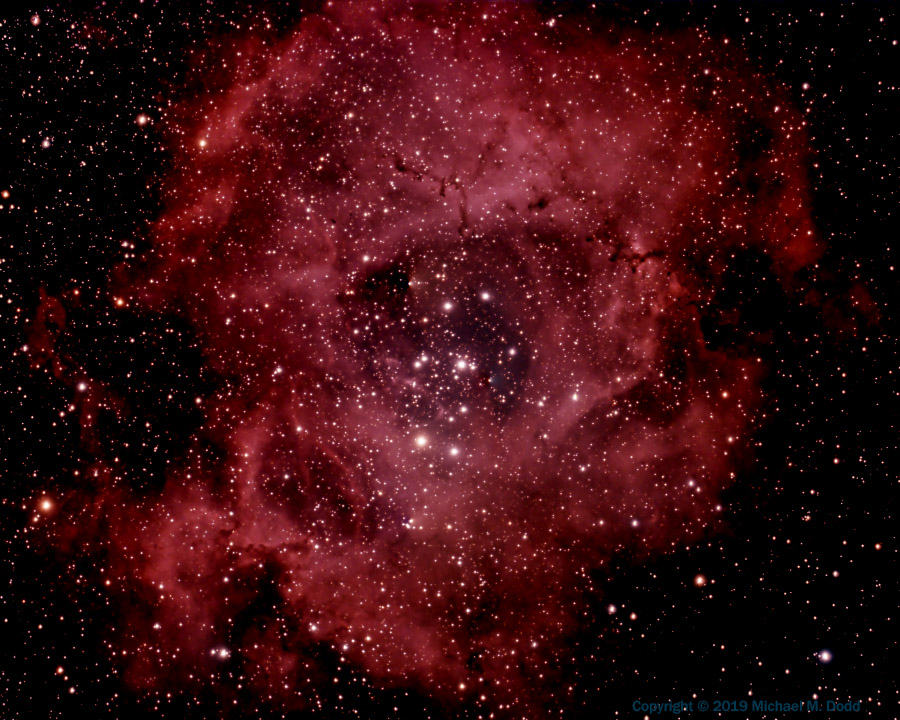
This two-panel mosaic was made with a color camera exposing full-color subs through a clear filter, plus additional subs through a hydrogen-alpha filter to strengthen the red but keep the stars under control.
| Exposure |
Two-panel mosaic:
• Each panel: 3 hours @ -20°C. ☞ Full-color: 20 @ 5 minutes (1⅔ hours) ☞ H-α: 8 @ 10 minutes (1⅓ hours) • Dusk flats • Camera position angle: 69.3° |
| Processing |
• Calibration, registeraton, and stretching with PixInsight • Final tweaking in Photoshop CS6 |
| Date and Location |
• December 7 & 21, 2019 • Louisa County, Virginia, USA |
|
Equipment |
• TMB-130SS APO refractor @ f/7 on an A-P 1200 mount • ZWO ASI-1600MC Pro color camera • Guided with an ST-402 camera on a 60mm f/5 scope • Imaging and autoguiding with MaxIm DL 6.20 • Automated image acquisition with ACP Observatory Control |
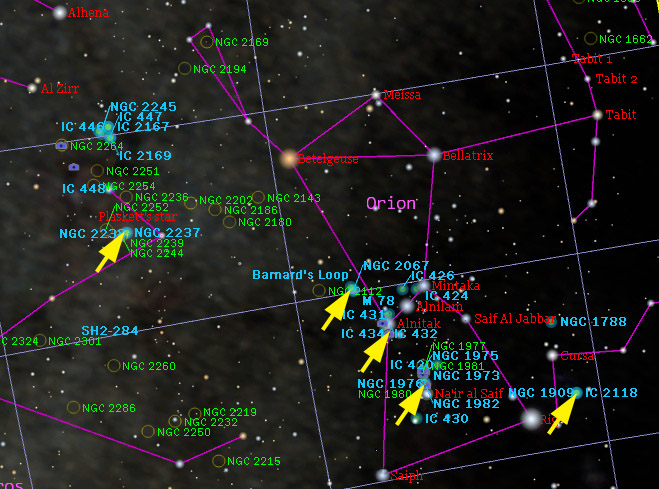
This region of the winter sky contains several beautiful deep-space objects in addition to the Rosette Nebula pictured above.
Hover your mouse over a yellow arrow below to see the name of an object. Click on the arrow to see my image of it.
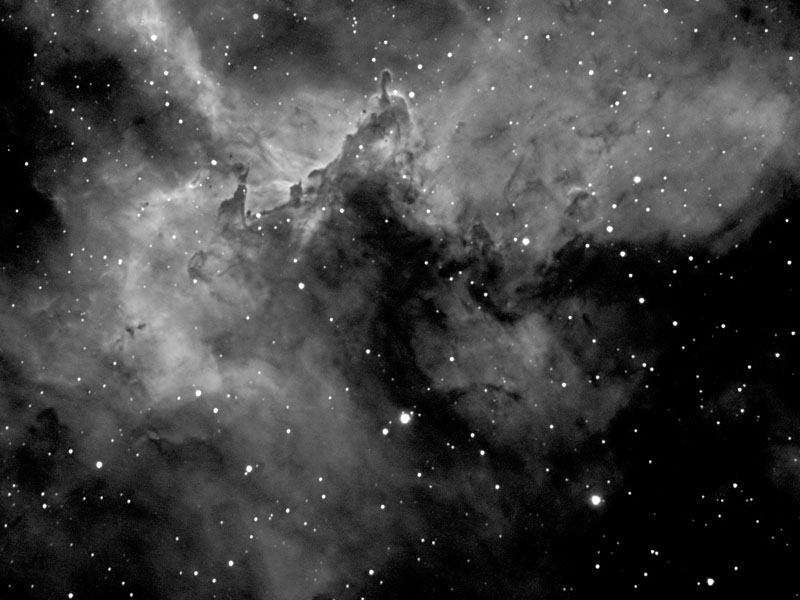
In the southeast quadrant of the Rosette can be seen several pillars known as "elephant trunks" rising from the surrounding molecular hydrogen gas and dust. The pillars are so dense that gravity contracts the gas to form stars. At the end of the pillars, radiation from the young stars boils away the lower-density material, revealing the stars' gaseous "cocoons." Ultimately the cocoons themselves will boil away, exposing the stars themselves.
This image comprises a total of three hours exposure.
| Exposure |
|
||
| Processing |
Master dark frame: 32 x 15 min. sigma-reject combined Dark and flat frame reduction in CCDSoft Levels and curves, Neat Image, highpass filter in Photoshop CS |
||
| Date and Location |
27-28 January 2005
Montpelier, Virginia, USA |
||
| Equipment |
Celestron 9¼" at f/5.6 on a Celestron CGE equatorial mount SBIG ST-8XM camera Optec IFW filter wheel with Astrodon TruBalance filters Optec TCF-S focuser Optec Pyxis camera rotator Imaging and autoguiding with MaxIm DL 4.11 |
Rosette Nebula, Northwest Region |
||
|
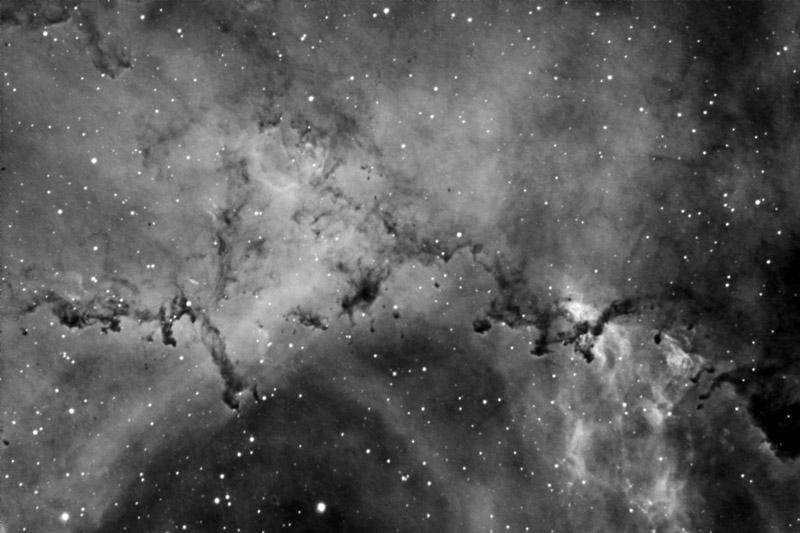
Along the Rosette's northern arc, two cloud tendrils spiral together to make a distinctive "Y" shape. Several small star-forming pillars are found along these clouds, at the bottom of the spiral, and in the dark clouds toward the right (west). Click here for the general view showing the northern and western regions. |
||
| Exposure |
|
||
| Processing |
Master dark frame: 4 x 10 min. sigma-reject combined Dark and flat frame reduction in CCDSoft Levels and curves, Gaussian blur, highpass filter in Photoshop CS |
||
| Date and Location |
18 & 26 February 2006
Montpelier, Virginia, USA |
||
| Equipment |
Celestron 9¼" at f/5.6 on CGE equatorial mount SBIG ST-8XM camera Optec IFW filter wheel with Astrodon filters Optec TCF-S focuser Optec Pyxis camera rotator Imaging and autoguiding with MaxIm DL 4.11 |
Updated May 23, 2023