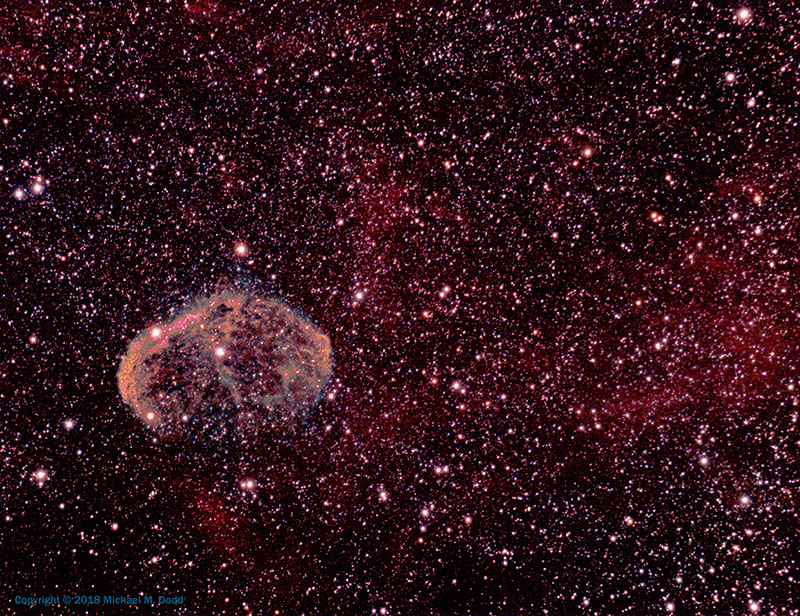
The Crescent Nebula, in the constellation Cygnus, is the result of a red giant star that used up all its hydrogen fuel and expelled its outer shell of gas. About 250,000 years ago, the star evolved into a Wolf-Rayet type and began producing a strong stellar wind as it burned heavier elements. The wind collided with the hydrogen cloud from the first phase, compacting it into complex shells. Strong ultraviolet radiation ionizes the hydrogen gas, causing it to glow red. The star, WR136, will likely explode as a supernova within the next million years.
This image was made with a color camera using a clear filter, plus additional subframes with Hydrogen-alpha and Oxygen-iii narrowband filters.
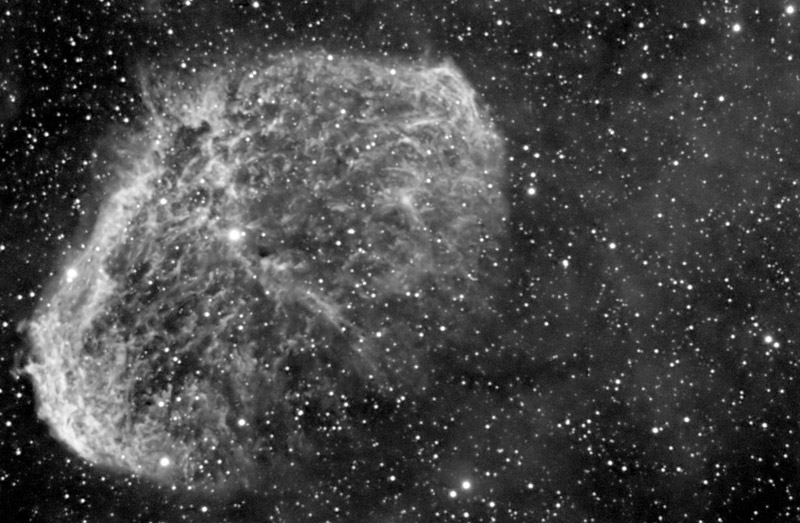
The monochrome Hydrogen-α image at the bottom of the page shows a closeup of the nebula through a different telescope and camera.
| Exposure |
• 8 hours @ -10°C ☞ Full-color: 3⅔ hours (22 @ 10 minutes). ☞ H-α: 2⅓ hours (14 @ 10 minutes). ☞ O-iii: 2 hours (12 @ 10 minutes). • Dusk flats • Camera position angle: 301° |
| Processing |
• With PixInsight: ☞ Calibration and star registeraton ☞ Subframe integration ☞ Histogram transformation ☞ Background noise reduction ☞ Star size reduction. ☞ Pixel math to enhance narrowband nebulosity. • Final tweaking in Photoshop CS6 |
| Date and Location |
• July 9, 10, & 13, 2019 • Louisa County, Virginia, USA |
|
Equipment |
• TMB-130SS APO refractor @ f/7 on an A-P 1200 mount • ZWO ASI-1600MC Pro color camera • Guided with an ST-402 camera on a 60mm f/5 scope • Imaging and autoguiding with MaxIm DL 6.20 • Automated image acquisition with ACP Observatory Control |
This image illustrates how well a Hydrogen-α filter can capture the faint nebulosity near the Crescent Nebula. This was captuted in 2006 at our former observatory using a telescope and camera with a much smaller field-of-view.
| Exposure |
|
|
| Processing |
Dark and flat processing in CCDStack Images combined with SD Mask in CCDStack Levels and curves, highpass filter in Photoshop CS |
|
| Date and Location |
July 8, 16, 26, & 29, 2006
Montpelier, Virginia, USA |
|
|
Equipment |
Celestron 9¼" at f/7.5 on a Celestron CGE equatorial mount SBIG ST-8XM camera SBIG CFW-10 filter wheel with Astrodon TruBalance filters Optec TCF-S focuser Optec Pyxis camera rotator Guide scope: 60mm f/5 refractor and ST-402 camera Imaging and autoguiding with MaxIm DL 4.11 |
Updated May 23, 2023